An introduction to toroidal Go
TL;DR
11x11 t-Go is a fascinating game. It tends to lead to whole-board fighting and yose situations. I give some thoughts on how I play it and I show some of my games using a new technique (hacking toroidal SGF data for usage with a standard SGF viewer).
Background
A while ago I was asked a few questions about toroidal Go on a discussion thread in Facebook. As I have some experience in playing this unusual game I decided to discuss this topic in a little depth here, rather than just giving short answers on the discussion thread.
About me: my name is Malcolm Schonfield; I’m 43 years old at time of writing and I’ve been playing Go since 1994. My top ranking in normal Go in France (FFG – Fédération Française de Go) was 1 dan; at the moment I’m a 1 kyu. I’m British and have lived in France for over 20 years. As I learnt to play Go in France I would describe myself as a French Go player.
Since the end of 2012 I’ve played correspondence Go and toroidal Go on “Little Golem” which is a website dedicated to playing strategy games by correspondence. A game on Little Golem typically takes months; I tend to play only a few moves on Little Golem every day; generally I have between 5 and 10 games (of either normal or toroidal Go) underway simultaneously.
Introducing toroidal Go
One way of describing t-Go (I will use this term from now on instead of “toroidal Go”) is that it is Go, with standard rules, played on a board where the edges “wrap around” horizontally and vertically: they link up with each other so all points have 4 neighbours; a point on the far left is linked to a point on the same horizontal line on the far right. If you’ve ever played the game Pac-Man you’ll be familiar with the idea – in that game there’s a tunnel linking up the left side with the right side that wraps around the edge of the screen.
A Go player needs to do quite a lot of “reading” (looking at possible variations) in order to play well. However, if the board is just simply displayed as a n x n grid, then reading sequences on the edges of the grid would be extra hard because neighbouring points are displayed on opposite sides. One way I’ve seen that makes reading easier is to add a few lines around the grid in order to show how the board meets up with itself on the sides. This method is used by Little Golem (it adds 3 extra lines all around the grid).
I’ve come up with a way of adapting SGF files for t-Go so they can be used with standard SGF apps to show 11x11 t-Go with 4 extra lines around the board. I wrote the software (it’s a bit of a hack actually) especially for this post; I think it will also be useful for other t-Go players on Little Golem.
As a first example, here’s a game I played some time ago. These days I wouldn’t play the opening that way but it’s still one of my favourite games.
Playing t-Go
The only sort of t-Go I have ever played is 11x11 no-handicap correspondence (on Little Golem) with komi of 4.5. Little Golem doesn’t let you play on other board sizes or with different komi. So mostly here I will limit myself to discussing this sort of t-Go (no handicap; 11x11; komi 4.5).
I started playing t-Go on Little Golem in December 2012. At the time of writing, I’ve completed 73 games (of t-Go), with 67 wins and 6 losses. I think I’m the number one t-Go player on Little Golem in terms of numbers of games played and winning percentage. I’m pleased with this achievement of course but I don’t think it’s such a very big deal as none of the t-Go players are high-level players of normal Go. There are a few players who seem to be more or less at my skill level on t-Go but in the main I’ve got lucky against them. I would expect to lose a game of t-Go against a pro or a high-dan amateur player of normal Go.
My experience in amateur tournament Go helps me see when I’m behind in the middle game and need to exploit, or provoke my opponents’ mistakes. But probably the main reason for my good results on Little Golem is how I’m particularly careful and take my time to choose moves. Often I find myself in a situation where I’m not sure how to play. I’ll think about it for a while and if I can’t come up with an idea that I like then I’ll leave the game and come back to it later. Sometimes days go by before I come up with a candidate move, and after that the candidate move needs to be backed up with some reading.
I think there is quite a strong correlation between skill in normal Go and in t-Go. A skilled player in normal Go (19x19 no-handicap Go) will be able to use their techniques (such as tesuji, shape, fighting, yose, positional evaluation, reading, and so on) to good effect on t-Go. However a lot of the knowledge of the fuseki (opening) and joseki from normal Go is useless in t-Go. It can work the other way round too. I believe my play of normal Go has improved a little thanks to experience gained playing t-Go.
Fuseki (opening phase) in t-Go
In the fuseki as Black I tend to aim for several things at once. I try to develop territorial frameworks (I choose this term instead of “moyo” because on an 11x11 board frameworks have to be fairly small). I try to make them large enough in scale so that White has to make thin shape in order to prevent them from becoming territory. I look out for opportunities to split White into separate groups with thin shape. I also try not to let my shape become too thin.
With White I attempt to limit Black’s territorial development without making overly thin shape; if neither player has large territories at the end there is more chance that the komi will swing the balance in White’s favour. I usually find myself at a disadvantage with White; with a komi of 4.5 I would prefer to have Black. I would like to try playing with a komi of 7.5. I used to believe that the “correct” value of the komi (i.e. the correct komi for players like AlphaGo) could well be 7.5. But these days I’m not too sure anymore; I actually have no idea! Maybe 4.5 is too much for top level players.
Still, with either colour I usually find the fuseki (opening) quite bewildering. I generally feel pretty lost. I have the feeling I have tended to play worse with White than with Black at this phase of the game.
With the advent of DeepMind’s AlphaGo, all sorts of new ways of playing have appeared in normal Go and I think it’s also given me some new perspectives for playing t-Go. In my more recent games I feel I’ve changed the way I play the fuseki. One thing I tend to aim at nowadays is to keep the position flexible, particularly as White. For the first two or three moves I try to avoid making several plays (like kosumi, tobi or keima) in the same area. Here’s an example from a game that is still underway, at time of writing. I feel fairly happy with my play here, even though I’m pretty sure my moves are miles away from what something like AlphaGo could do.
Here’s a game I lost. After a quick review I now believe I started to fall behind after move 10. For move 10 I now feel more like playing a sort of pincer at a55 (using Audouard coordinates). That seems to give a more flexible development. Also I think move 16 is too slow; it’s really hard to catch up after Black surrounds territory with move 17. Move 16 would probably also be better at a55.
The chuban (middle game)
I find the chuban (middle game) very hard too but I generally don’t feel so lost during this phase. Objectives start to become clearer. Against other experienced t-Go players I find myself more and more in middle-game situations where hardly anything is fixed; everything is in flux. For me this is one of the good things about t-Go. The trick to playing well at this stage is to lead the game towards a favourable whole-board semiai/tsumego/yose situation. Easier said than done!
Here is a game where I have Black. I make a cut early on and it ends up working well. It’s quite a dynamic, fighting game featuring a ko fight. Actually, I feel that in t-Go, cutting in the opening sometimes is not such a good option; it tends to be less good than in normal Go.
Comparisons with normal Go
In t-Go, the board is completely homogeneous, unlike normal Go. Without the edges the game seems somehow much more open and wider then playing normal Go on an 11x11 board. The potential for linking up groups in all directions makes a big difference.
As in normal Go, trying to make eyes in the fuseki does not seem to be a good strategy. Also, aiming to kill a group in the chuban seems to be rather hard in general. When a group links up with itself by making a circle, a “false eye” can work as a “real eye” for making life. (This exists in normal Go too, but it’s quite a rare situation. In t-Go I think it’s more common). But it can be difficult to handle a situation where you are split into two groups that do not yet each have two definite eyes.
I never did play a game of 11x11 normal Go, but I’ve played lots of games of 13x13 normal Go (mostly handicap games, as White; I’ve not played much no-handicap 13x13 normal Go) and somehow it feels to me like 11x11 t-Go is “larger” and more complex than 13x13 normal Go! I think this is related to how in normal Go an experienced player knows that playing on the first and second lines in the fuseki is not a good idea; so two lines on the four edges are disregarded, at least in the fuseki, in normal Go, unlike in t-Go.
Kos seems to be slightly less common in t-Go than in normal Go. So does seki – I’ve never seen a seki in any of my games so far.
Software; Dao Qi (道棋)
Hardly any software is available for t-Go. The sort of basic tools we take for granted with normal Go don’t work for T-Go. I think the first tool that’s needed is a full featured SGF editor/viewer.
The technique I’m using here for displaying my games is basically a hack. It’s tailor-made for viewing games from Little Golem. I would say it’s alpha-stage software – it doesn’t handle placing moves on the board for analysing variations. It uses javascript and also builds on some code by Nate Eagle (smartgame and smartgamer libraries). I expect I will open source the code at some point. In the meantime, this page gives a simple tailor-made tool for viewing for t-Go SGF from Little Golem.
Actually, I do know of one SGF editor that works with t-Go, but it lacks features to help reading the situation where the board meets up with itself. Features needed would be like the extra lines I use for the SGF viewer in this article, or else being able to move the area displayed – I won’t go into the details. This editor is available in Chinese at this page.
The people at Dao Qi seem really interested in t-Go; they use the term Dao Qi (道棋) to describe t-Go. I’ve had a look at their website but I’m very slow at reading Chinese and I don’t feel like using auto-translate tools, so I haven't got round to reading it properly.
Other variants
I’m not sure that t-Go would be so interesting on a 19x19 board because for me the board would be too large – I mentioned above how 11x11 t-Go seems larger than 13x13 normal Go. Still, I would like to try playing 13x13 t-Go; maybe 15x15 t-Go would be interesting too.
There are two other ways to remove the edges for a finite square grid. In mathematics (topology) these are called a Klein surface and a projective plane. I would expect Go on these surfaces to be quite similar to t-Go.
toroid: 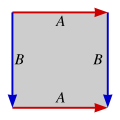
klein: 
projective plane: 
I would be keen to play Go on a quite different board that does have edges: a diamond lattice. I never got a chance to do so however.
I would like to close by mentioning a totally different variant that I only got to play once, but which I found very interesting: “veto Go” (it has also been referred to as “Forced Takeback Go”). It’s described in Sensei’s library here; at the moment that page could do with a major revision…
Conclusion
Thank you if you’ve read all the way to the end of this article! I hope you enjoyed it and I hope you liked looking at the sample games. I hope you agree with me that t-Go is a fascinating game. Please feel free to leave a comment.
I hope to blog a little about more of my favourite games over the next few months. I encourage Go players to come and try t-Go on Little Golem, and I encourage programmers to help develop some tools for t-Go and other Go variants.
Revisions
2024-08-07: Fixed the javascript - it had been broken at some point