2018-08-03

En pensant à Michel Lahittete

Mon cher ami et collègue, Michel Lahittete, est disparu le 11 juillet 2018. C’était un événement choquant et tragique. Je pense souvent à lui et aux bons moments que nous avons passés ensemble.

Michel avait un sens d’humour exquis et était un compagnon de jeu précieux. Depuis leur début en 2010, il venait avec assiduité aux ateliers hebdomadaires «jeu de go» que j’anime à l’heure du déjeuner à l’OCDE. Au go il avait le niveau de 8 kyu environ, bien qu’il n’ait jamais pratiqué de tournoi. Il était toujours prêt à partager autour de go avec des joueurs novices ou expérimentés, que ce soit avec des parties pédagogiques ou à égalité, des analyses de partie ou de position, ou simplement d’observer une partie en train de se disputer.

Michel se passionnait pour les échecs et aimait aussi partager ses connaissances extrêmement étendues dans ce domaine. De temps en temps, et de plus en plus fréquemment ces dernières années, je le retrouvais une seconde fois par semaine, lors de l’atelier «échecs» qu’il animait. Il était bien plus fort que moi mais nous avons pu jouer quelques belles parties ; j’aimais aussi voir comment lui et d’autres joueurs forts analysait ensemble tout en m’expliquant les enjeux pour que je ne sois pas complètement perdu ! Cette échange, où nous étions chacun à tour de rôle animateur de session et participant/apprenant, était très intéressante et enrichissante.

Je sais que de très nombreuses personnes, à l’OCDE et ailleurs, gardent Michel dans leurs pensées et le regrettent. Mes condoléances vont à sa famille.

Malcolm Schonfield

Une traduction en anglais de ce texte suit ci-dessous.

(English translation of the original text above in French.)

Thinking of Michel Lahittete


My dear friend and colleague, Michel Lahittete, died on 11 July 2018. It was tragic, shocking news. I often think of him and the good times we had together.

Michel had a great sense of humour and was a great partner for games. From the beginning in 2010, he was a regular attendee at the weekly lunchtime Go sessions I organise at the OECD. He played at about 8 kyu level, even though he never played in any tournaments. He was always happy to join in with players of all levels, in handicap and no-handicap games, in game and problem analysis, and also just by watching a game underway,

Michel loved chess and loved to share his extensive chess knowledge. Occasionally over the years, and more and more frequently in the last year or so, I would see him a second time in the week, at one of the lunchtime chess sessions he organised. He was much stronger than me but we still played some nice games, and I really enjoyed seeing him and other strong players carrying out analysis while still managing to explain enough for me to feel I was keeping up. It was a great experience to switch between being the teacher/organiser and being a participant/learner.

I know that many people at the OECD and elsewhere keep Michel in their thoughts and miss him. I send my condolences to his family.

Malcolm Schonfield

Voici quelques photos, prises au fil du temps aux ateliers de jeu de go.
Here are a few photos I took over the years at the Go sessions.
2017: Jérôme, JoongKwon, Michel

2017: Michel, Aliette, JoongKwon, Yoshihiro

2017: Aliette, JoongKwon, Jean-Alexis, Michel, Malcolm
2017: Yoshi (Koichiro), Aliette, JoongKwon, Jean-Alexis, Michel

2017: Aliette, Yoshihiro, Michel

2015: Michel, David, Pavel

2012: Michel, Sylvain
Toutes ces photos sont disponibles dans leur format originel ici.
All these photos can be found in their original format here.
2018-05-13

livraison de bois remportée ; partie de go jouée

Suite à un problème de date avec une livraison de bois, j'ai pu jouer une petite partie avec Jean-Mi ! Il y avait beaucoup de choses intéressantes. La partie s'est terminée avec un snapback plutôt joli !

2018-05-01

Divide and conquer (1): it lived too easily!

In 11x11 toroidal Go, aiming to make eyes isn’t always easy, nor is it a good primary goal to aim at. One strategy can be to try to split the opponent into two eyeless groups and then aim at killing one of them. I have in mind a series of blog posts about games involving this theme.

For my first post on this topic, here is a game where I succeeded in splitting up my opponent’s groups, but I made a big mistake by letting one of them live too easily. That mistake should have cost me the game, but then it turned out my opponent didn’t see the danger for the other group until it was too late!

Here is a short resume of the game. For more details, I invite you to look through some of the variations I’ve provided. I hope you enjoy having a look!

The fuseki here is interesting. After 14 White has a coherent strategy but 16 may be a little too far into Black’s framework. Black tries to separate White into two groups and the ensuing fighting is quite tough. Black 39 is a mistake as it lets White live too easily. When White lives with 44 Black is in a difficult situation and has to try to kill the other white group, or at least use an attack on it to gain a lot of territory.

In the next few moves White missed several opportunities to reinforce. After 66 it took me a long time to come up with the tenuki at 67 in order to keep on trying to kill White. After 69 things look very promising for Black but I was only certain that White was dead after 77. Funnily enough instead of resigning straight away White played on until all the stones were removed from the board.

Edit log
(2021-07-05): Minor edits/typos + a little change to the go commentary. (a] “…for White” → “…for Black” in variation for move #16; b] capital letter “I” at the start of a sentence; c] added link to SL for “tenuki”; d] “fuseki” → “opening”; e] revised the diagram at the end of the 2nd branch of the variation given for white 18)

2018-03-16

Toroidal Go - a commentary on a memorable game with a few ups and downs

Here is a correspondence game of toroidal Go (t-Go) I played in 2014. It’s not one of my very best games – some fairly basic mistakes were made by both players – but there are some exciting moments and some interesting shapes. It was a memorable game in which I came back from a difficult position. I’ve found it interesting to review it, four years afterwards. I hope you enjoy having a look.

I took White in this game. I think the fuseki went well for me, but I made a heavy move (move 30) which I think could have cost me the game. In the end Black missed a connection and the game ended with an exciting large-scale capture.

There are hardly any other commentaries of t-Go games available at the moment, and very little literature about t-Go. At some point I hope better players than myself will follow my lead and provide more insightful and inspiring game commentaries.

Updates log
2018-04-18: I’ve revised the commentary. The main change is to add a fairly in-depth look at some variations after move 64.
2018-04-30: 1) A few minor tweaks to parts of the introduction; 2) software update.

2017-12-22

Toroidal Go viewer (2) - an improved version that handles variations

Update, 2018-01-05: This is an old version of the software that is kept so as not to break existing links elsewhere. The latest version, which can be used as an editor, is available here.

Paste SGF for a game of toroidal Go (e.g. from Little Golem) in the box below, and then push the button to view the game!
(number of wraparound lines to add)

This viewer for t-Go works using the library Go-Variants-Transformer on top of Ilya Kirillov’s SGF viewer.

A big fight in a game of toroidal Go - same game, but with variations!

Here is the game I showed in my previous post, along with some comments and variations. I hope you enjoy looking through it.

By the way, I’ve made some improvements to my software for displaying t-Go games in web browser: the software now handles variations, and lets you “pan” the board around (i.e. move the “centre” of the board around). The software is still in an alpha stage; it’s a bit rough around the edges, but hopefully it will work OK for most people. It’s only had some light testing on Chrome and Firefox, on a Windows 7 box.

This software is open source; here is a link to the project on githup: link. In a previous version I hooked up my code to the “WGo.js” SGF viewer, but for various reasons I use a different library here (a library called “GoProject” by Ilya Kirillov).

Update, 2017-12-25: added a variation after move 45.

Update, 2018-03-18: fixed bug (page wasn’t working).

Update (2018-04-03): updated to use the latest version of the software.

2017-10-06

A big fight in a t-Go game

Here is one of the most exciting, violent t-Go games I ever played. Unfortunately I still don’t have an easy way of showing variations for the game, but I think it’s still worthwhile for me to share some of my thoughts and memories about the game. I only spent a few minutes reviewing for this blog post, but I spent hours on some those moves. So I may well have forgotten some things or got some things wrong in the following analysis.

I think my play in the fuseki was a little too extreme or optimistic. I think White played very well. After 22 I felt I was in a difficult position. I took a long time trying to find moves to stay in the game. In particular I remember 33 took me a long time – an alternative I considered was the kosumi at 50. 33 makes bad shape but it does remove a white liberty. After 33 I think it would be better for White to play a tobi at 40 to fix the shape. When I played 35 I had read out the moves to 43 as a possible continuation; it seems to be good for Black but it’s hard to be sure. After White cuts with 48 Black’s group is very weak, but both sides are short of liberties so the fighting is not over; it’s a very interesting position. Black can’t avoid the ko, but it seems to be unfavorable for White.

I hope you enjoy having a look!

Update, 2017-10-24: it seems 47 and 48 are mistakes. If 48 is played as a cut at 49, then I can’t see how Black can avoid losing some key stones. For 47 I probably should have played the “shape” move, a kosumi (diagonal) at 50. Then the position is unclear to me, but still seems better than in the variation for 48. (Credit: the variation for 47 was pointed out by “gamesorry”, who may well be the strongest t-Go player on littleGolem.)

Update, 2017-12-23: See this new blog post for further discussion of the same game, but with variations that are viewable using the browser (I have improved the software I’m using to blog about t-Go so it can handle variations).

As a bonus, here is another interesting game with the same players during the same tournament in littleGolem. In this game I had White.

2017-06-16

t-Go viewer for Little Golem

Update, 2018-01-05: This is an old version of the software that is kept so as not to break existing links elsewhere. The latest version, which can be used as an editor, is available here.

Paste SGF for a t-Go game from Little Golem here and push the button! (alpha software, provided “as is”. Variations are not handled.

An introduction to toroidal Go

An introduction to toroidal Go

TL;DR

11x11 t-Go is a fascinating game. It tends to lead to whole-board fighting and yose situations. I give some thoughts on how I play it and I show some of my games using a new technique (hacking toroidal SGF data for usage with a standard SGF viewer).

Background

A while ago I was asked a few questions about toroidal Go on a discussion thread in Facebook. As I have some experience in playing this unusual game I decided to discuss this topic in a little depth here, rather than just giving short answers on the discussion thread.

About me: my name is Malcolm Schonfield; I’m 43 years old at time of writing and I’ve been playing Go since 1994. My top ranking in normal Go in France (FFG – Fédération Française de Go) was 1 dan; at the moment I’m a 1 kyu. I’m British and have lived in France for over 20 years. As I learnt to play Go in France I would describe myself as a French Go player.

Since the end of 2012 I’ve played correspondence Go and toroidal Go on “Little Golem” which is a website dedicated to playing strategy games by correspondence. A game on Little Golem typically takes months; I tend to play only a few moves on Little Golem every day; generally I have between 5 and 10 games (of either normal or toroidal Go) underway simultaneously.

Introducing toroidal Go

One way of describing t-Go (I will use this term from now on instead of “toroidal Go”) is that it is Go, with standard rules, played on a board where the edges “wrap around” horizontally and vertically: they link up with each other so all points have 4 neighbours; a point on the far left is linked to a point on the same horizontal line on the far right. If you’ve ever played the game Pac-Man you’ll be familiar with the idea – in that game there’s a tunnel linking up the left side with the right side that wraps around the edge of the screen.

A Go player needs to do quite a lot of “reading” (looking at possible variations) in order to play well. However, if the board is just simply displayed as a n x n grid, then reading sequences on the edges of the grid would be extra hard because neighbouring points are displayed on opposite sides. One way I’ve seen that makes reading easier is to add a few lines around the grid in order to show how the board meets up with itself on the sides. This method is used by Little Golem (it adds 3 extra lines all around the grid).

I’ve come up with a way of adapting SGF files for t-Go so they can be used with standard SGF apps to show 11x11 t-Go with 4 extra lines around the board. I wrote the software (it’s a bit of a hack actually) especially for this post; I think it will also be useful for other t-Go players on Little Golem.

As a first example, here’s a game I played some time ago. These days I wouldn’t play the opening that way but it’s still one of my favourite games.

Playing t-Go

The only sort of t-Go I have ever played is 11x11 no-handicap correspondence (on Little Golem) with komi of 4.5. Little Golem doesn’t let you play on other board sizes or with different komi. So mostly here I will limit myself to discussing this sort of t-Go (no handicap; 11x11; komi 4.5).

I started playing t-Go on Little Golem in December 2012. At the time of writing, I’ve completed 73 games (of t-Go), with 67 wins and 6 losses. I think I’m the number one t-Go player on Little Golem in terms of numbers of games played and winning percentage. I’m pleased with this achievement of course but I don’t think it’s such a very big deal as none of the t-Go players are high-level players of normal Go. There are a few players who seem to be more or less at my skill level on t-Go but in the main I’ve got lucky against them. I would expect to lose a game of t-Go against a pro or a high-dan amateur player of normal Go.

My experience in amateur tournament Go helps me see when I’m behind in the middle game and need to exploit, or provoke my opponents’ mistakes. But probably the main reason for my good results on Little Golem is how I’m particularly careful and take my time to choose moves. Often I find myself in a situation where I’m not sure how to play. I’ll think about it for a while and if I can’t come up with an idea that I like then I’ll leave the game and come back to it later. Sometimes days go by before I come up with a candidate move, and after that the candidate move needs to be backed up with some reading.

I think there is quite a strong correlation between skill in normal Go and in t-Go. A skilled player in normal Go (19x19 no-handicap Go) will be able to use their techniques (such as tesuji, shape, fighting, yose, positional evaluation, reading, and so on) to good effect on t-Go. However a lot of the knowledge of the fuseki (opening) and joseki from normal Go is useless in t-Go. It can work the other way round too. I believe my play of normal Go has improved a little thanks to experience gained playing t-Go.

Fuseki (opening phase) in t-Go

In the fuseki as Black I tend to aim for several things at once. I try to develop territorial frameworks (I choose this term instead of “moyo” because on an 11x11 board frameworks have to be fairly small). I try to make them large enough in scale so that White has to make thin shape in order to prevent them from becoming territory. I look out for opportunities to split White into separate groups with thin shape. I also try not to let my shape become too thin.

With White I attempt to limit Black’s territorial development without making overly thin shape; if neither player has large territories at the end there is more chance that the komi will swing the balance in White’s favour. I usually find myself at a disadvantage with White; with a komi of 4.5 I would prefer to have Black. I would like to try playing with a komi of 7.5. I used to believe that the “correct” value of the komi (i.e. the correct komi for players like AlphaGo) could well be 7.5. But these days I’m not too sure anymore; I actually have no idea! Maybe 4.5 is too much for top level players.

Still, with either colour I usually find the fuseki (opening) quite bewildering. I generally feel pretty lost. I have the feeling I have tended to play worse with White than with Black at this phase of the game.

With the advent of DeepMind’s AlphaGo, all sorts of new ways of playing have appeared in normal Go and I think it’s also given me some new perspectives for playing t-Go. In my more recent games I feel I’ve changed the way I play the fuseki. One thing I tend to aim at nowadays is to keep the position flexible, particularly as White. For the first two or three moves I try to avoid making several plays (like kosumi, tobi or keima) in the same area. Here’s an example from a game that is still underway, at time of writing. I feel fairly happy with my play here, even though I’m pretty sure my moves are miles away from what something like AlphaGo could do.

Here’s a game I lost. After a quick review I now believe I started to fall behind after move 10. For move 10 I now feel more like playing a sort of pincer at a55 (using Audouard coordinates). That seems to give a more flexible development. Also I think move 16 is too slow; it’s really hard to catch up after Black surrounds territory with move 17. Move 16 would probably also be better at a55.

The chuban (middle game)

I find the chuban (middle game) very hard too but I generally don’t feel so lost during this phase. Objectives start to become clearer. Against other experienced t-Go players I find myself more and more in middle-game situations where hardly anything is fixed; everything is in flux. For me this is one of the good things about t-Go. The trick to playing well at this stage is to lead the game towards a favourable whole-board semiai/tsumego/yose situation. Easier said than done!

Here is a game where I have Black. I make a cut early on and it ends up working well. It’s quite a dynamic, fighting game featuring a ko fight. Actually, I feel that in t-Go, cutting in the opening sometimes is not such a good option; it tends to be less good than in normal Go.

Comparisons with normal Go

In t-Go, the board is completely homogeneous, unlike normal Go. Without the edges the game seems somehow much more open and wider then playing normal Go on an 11x11 board. The potential for linking up groups in all directions makes a big difference.

As in normal Go, trying to make eyes in the fuseki does not seem to be a good strategy. Also, aiming to kill a group in the chuban seems to be rather hard in general. When a group links up with itself by making a circle, a “false eye” can work as a “real eye” for making life. (This exists in normal Go too, but it’s quite a rare situation. In t-Go I think it’s more common). But it can be difficult to handle a situation where you are split into two groups that do not yet each have two definite eyes.

I never did play a game of 11x11 normal Go, but I’ve played lots of games of 13x13 normal Go (mostly handicap games, as White; I’ve not played much no-handicap 13x13 normal Go) and somehow it feels to me like 11x11 t-Go is “larger” and more complex than 13x13 normal Go! I think this is related to how in normal Go an experienced player knows that playing on the first and second lines in the fuseki is not a good idea; so two lines on the four edges are disregarded, at least in the fuseki, in normal Go, unlike in t-Go.

Kos seems to be slightly less common in t-Go than in normal Go. So does seki – I’ve never seen a seki in any of my games so far.

Software; Dao Qi (道棋)

Hardly any software is available for t-Go. The sort of basic tools we take for granted with normal Go don’t work for T-Go. I think the first tool that’s needed is a full featured SGF editor/viewer.

The technique I’m using here for displaying my games is basically a hack. It’s tailor-made for viewing games from Little Golem. I would say it’s alpha-stage software – it doesn’t handle placing moves on the board for analysing variations. It uses javascript and also builds on some code by Nate Eagle (smartgame and smartgamer libraries). I expect I will open source the code at some point. In the meantime, this page gives a simple tailor-made tool for viewing for t-Go SGF from Little Golem.

Actually, I do know of one SGF editor that works with t-Go, but it lacks features to help reading the situation where the board meets up with itself. Features needed would be like the extra lines I use for the SGF viewer in this article, or else being able to move the area displayed – I won’t go into the details. This editor is available in Chinese at this page.

The people at Dao Qi seem really interested in t-Go; they use the term Dao Qi (道棋) to describe t-Go. I’ve had a look at their website but I’m very slow at reading Chinese and I don’t feel like using auto-translate tools, so I haven't got round to reading it properly.

Other variants

I’m not sure that t-Go would be so interesting on a 19x19 board because for me the board would be too large – I mentioned above how 11x11 t-Go seems larger than 13x13 normal Go. Still, I would like to try playing 13x13 t-Go; maybe 15x15 t-Go would be interesting too.

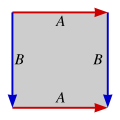
There are two other ways to remove the edges for a finite square grid. In mathematics (topology) these are called a Klein surface and a projective plane. I would expect Go on these surfaces to be quite similar to t-Go.

toroid: toroid

klein: klein

projective plane: projective plane

I would be keen to play Go on a quite different board that does have edges: a diamond lattice. I never got a chance to do so however.

I would like to close by mentioning a totally different variant that I only got to play once, but which I found very interesting: “veto Go” (it has also been referred to as “Forced Takeback Go”). It’s described in Sensei’s library here; at the moment that page could do with a major revision…

Conclusion

Thank you if you’ve read all the way to the end of this article! I hope you enjoyed it and I hope you liked looking at the sample games. I hope you agree with me that t-Go is a fascinating game. Please feel free to leave a comment.

I hope to blog a little about more of my favourite games over the next few months. I encourage Go players to come and try t-Go on Little Golem, and I encourage programmers to help develop some tools for t-Go and other Go variants.

Revisions
2024-08-07: Fixed the javascript - it had been broken at some point

2017-05-30

A commented 5-stone handicap game from Little Golem

Here is a commented 5-stone handicap game I played on Little Golem in recently; the comments are primarily for my opponent (Qola / Gabriel).

2016-09-13

Maître Lim

English version of this text - see below.

Maître Lim est décédé il y a quelques jours, et pour lui rendre hommage je voudrais partager deux de ses parties de Go. Je les ai trouvées sur une feuille A4 trouvée dans le tas de de papiers qui je pourrais appeler mes archives de Go. Je crois que M. Lim lui-même m’a donné cette feuille à l'époque, il y a presque 20 ans. Elle n’indique pas le vainqueur de chaque partie mais je suppose que Lim en a gagné une et perdu une ;-)

La première partie est contre MIYAKAWA Wataru, en 1997. Elle était jouée au tournoi d’Antony ; c’était l’un des derniers tournois (sinon le dernier ?) disputé par M. Lim. Wataru est un ancien insei et à l’époque était l’un des meilleurs joueurs résidant en France. Selon M. Lim, ceci est l’une de ses meilleures parties. Si je me le rappelle bien, il pensait que les cent premiers coups sont tous de niveau pro, c’est-à-dire que parmi eux il n’y a pas de mauvais coup. Je trouve que c’est tout à fait remarquable que malgré son âge avancé il ait pu vaincre un adversaire de ce calibre.

Je me souviens qu’à l’occasion M. Lim pouvait trop boire, mais pour ce tournoi il était tout à fait sobre. Je crois bien que j’étais présent à ce tournoi ; j’ai un souvenir de lui en train de boire sa petite bouteille d’eau.

Je trouve que c’est une jolie partie ; Noir joue patiemment. 89 me semble un beau tesuji mais je ne le comprends pas complètement. C’est peut-être dommage que je n’aie pas les coups après le joli tesuji en 125 mais c’est probablement pour le mieux – M. Lim aimait répéter que l’essentiel d’une partie de Go se trouve dans le fuseki.

La deuxième partie est une partie « amicale » jouée contre le très grand joueur pro CHO Hun Hyun 9d alors qu’il était de passage à Paris. Je ne sais pas exactement quels sont les coups que M. Lim regrettait mais le déroulement global de la partie ne me semble en effet pas favorable pour Noir.

Maître Lim était un grand personnage du Go français ; il nous manquera !

---

Maître Lim died a few days ago, and in his memory I would like to share two of his games. I found both these games on a single sheet of A4 paper in a pile of paper you could call my “go archives”. I probably was given the sheet by M. Lim himself - it was almost 20 years ago so I’m not sure! It doesn’t say who one either game, but my guess is that M. Lim won one and lost the other ;-)

The first game is against MIYAKAWA Wataru, in 1997. This game was played in one of Lim’s last tournaments, in Antony, France. His opponent is an ex-insei and at the time was perhaps the top player in France. According to M. Lim, this is one of Lim’s best games. If I remember correctly, he felt that the first one hundred or so moves of the game are “pro-level”. I think by this he meant there’s nothing wrong with any of them. Anyway, it’s quite an achievement for Lim, who was probably in his seventies, to win against an opponent of this calibre.

I believe I was at that particular tournament. I remember Lim could get a bit drunk on occasion but this time he was very sober; I remember him swigging away at a little bottle of mineral water.

Personally, I think it’s a nice game. Black plays patiently. 89 looks like a good tesuji to me but I don’t really understand it fully. Maybe it’s a pity I don’t have the moves after the pretty tesuji at 125 but then again it seems appropriate to leave out the yose – M. Lim would often say the main content of a game is in the fuseki.

The second game is a “friendly” played against a top player, CHO Hun Hyun 9p, when he was visiting Paris in 1979. I’m not sure which are the moves M. Lim found awful, but the flow certainly doesn’t seem good for Black.

Maître Lim was a striking figure in the French Go world; we will miss him.

2016-09-05

Une partie de Go dans le train

Voici une partie jouée récemment dans le train avec Ruben. Ruben habite dans la même ville que moi et n’a quasiment pas joué au Go. Donc c’est juste une partie « d’initiation » pour (re)découvrir le Go.

Dans la partie je montre quelques variations sans commentaire ; c’est en général des suggestions pour comment noir aurait pu jouer.
Blanc 38 est un petit tesuji de yose que j’étais content de jouer ;-)


Pour la petite histoire, c’est la deuxième fois que je joue au Go dans le train suite à une rencontre par hasard. L’autre fois c’était il y a un an environ. Dans le RER C en rentrant du travail, par hasard je discute avec un couple chinois et découvre que la fille joue au Go ! On a donc joué une partie sur un 9x9 ; elle était à peu près 5ième kyu.

2016-04-01

9 stone handicap game with comments

Here is a handicap game I played with Yoshi last week. It was just his second game on a 19x19 board; I think he’s doing very well!

2016-01-22

One of my correspondence games, commented by a stronger player

Here’s a correspondence game I played in 2015. I showed it to my friend Akito (a Japanese 6D) and he made a few comments (link on eidogo) which I found very thought-provoking and enlightening. I shared the eidogo link with my opponent “brownale” and he said the comments about the fuseki were particularly interesting.

I’ve added some comments of my own to Akito’s and here’s the final result. I hope you get something from this game and the comments.

Search This Blog